
Call us now :08045803029
 Send Inquiry
 Send Inquiry
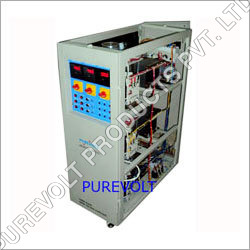
Three Phase Voltage Stabilizer
Price 145000 INR/ Piece
MOQ : 1 Piece
Three Phase Voltage Stabilizer Specification
- Output Current
- 43 A
- Input Voltage
- 340-470 V
- Output Voltage
- 400 Volt (V)
- Efficiency
- > 98%
- Frequency (MHz)
- 50 Hertz (HZ)
- Phase
- Three Phase
- Current
- Up to 43A
- Weight
- 350 kg
- Ambient Temperature
- 0C to 50C
- Degree of Protection
- IP21
- Control System
- Automatic
- Usage
- Industrial / Commercial Equipment
- Design
- Floor Mounted
- Insulation Resistance
- > 5 M at 500V DC
- Voltage Protection
- Under & Over Voltage Protection
- Display
- Analog
- Dimension (L*W*H)
- 950 x 500 x 1300 mm
- Rated Power
- 30 kVA
- Current Type
- AC
- Waveform Distortion
- Nil
- Product Type
- Three Phase Voltage Stabilizer
- Bypass Switch
- Manual/Automatic
- Regulation
- ±1%
- Overload Protection
- Yes
- Color
- Grey & Blue
- Response Time
- <10 ms
- Suitable For
- Voltage Sensitive Equipment
- Mounting Type
- On Wheels
- Type of Transformer
- Copper Wound
- Material
- CRCA Sheet
- Cooling Type
- Air Cooled
Three Phase Voltage Stabilizer Trade Information
- Minimum Order Quantity
- 1 Piece
- Payment Terms
- Letter of Credit (L/C), Cheque
- Supply Ability
- 100 Pieces Per Week
- Delivery Time
- 2 Week
- Packaging Details
- Box
- Main Export Market(s)
- Middle East, Africa
- Main Domestic Market
- All India
About Three Phase Voltage Stabilizer
Three Phase Voltage Stabilizer possess outstanding characteristics like least waveform damage, high power factor, free from result of frequency change of supply and high efficiency. It is a completely mechanically compensated energy current stabilizer, utilized to balance the input current to safeguard the instruments from voltage variations. Our stabilizer is obtainable by the users in various technical specifications according to their demand.
We have possessed the capacity to achieve great market goodwill as a reliable producer and provider of Three Phase Voltage Stabilizer, which is utilized to give steady output current by regulating voltage fluctuations. We make stabilizer utilizing ideal quality materials and parts, procured from certified vendors.
Salient Characteristics:
We have possessed the capacity to achieve great market goodwill as a reliable producer and provider of Three Phase Voltage Stabilizer, which is utilized to give steady output current by regulating voltage fluctuations. We make stabilizer utilizing ideal quality materials and parts, procured from certified vendors.
Salient Characteristics:
- Can maintain output current steady when power supply change
- Popular for its light structure, simple installation as well as unwavering working
- Mechanical current control with broad input current range
Superior Voltage Regulation
Engineered with a precision control system, this stabilizer maintains output voltage within 1%, preventing fluctuations that could harm sensitive industrial and commercial equipment. Advanced protection circuits guard against voltage spikes, overloads, and provide seamless operation through both manual and automatic bypass options.
Efficient, Reliable Power Delivery
Equipped with a copper-wound transformer and an air-cooled design, this stabilizer operates at over 98% efficiency, ensuring minimal energy loss. Rated for up to 30 kVA and 43A output, it is ideally suited for demanding applications, supporting consistent power supply under varying load conditions without introducing waveform distortion.
User-Centric Design and Mobility
Housed in a durable CRCA sheet enclosure with grey and blue finish, this stabilizer features on-wheel mobility for easy relocation within your facility. The analog display, floor-mount design, and IP21 degree of protection make it convenient and safe for deployment in industrial and commercial environments across India.
FAQ's of Three Phase Voltage Stabilizer:
Q: How does the three phase voltage stabilizer protect voltage-sensitive equipment?
A: The stabilizer precisely regulates output voltage to 400V with 1% accuracy, automatically correcting under and over voltage conditions within 10ms. Integrated overload protection and both manual and automatic bypass switches further safeguard connected equipment from power disturbances.Q: What is the installation process for this voltage stabilizer?
A: Installation is straightforward-a floor-mounted design with wheels makes positioning easy. The unit connects to your three-phase AC supply, and suitable cable ratings should be used as per the output (up to 43A). Ensure proper grounding for safety and optimal functioning.Q: When should I use a voltage stabilizer of this specification?
A: Utilize this stabilizer when powering voltage-sensitive machinery or equipment in industrial or commercial settings, especially where voltage fluctuations are common and reliable 400V three-phase supply is essential. It is ideal for applications requiring high efficiency and rapid response to voltage changes.Q: Where can this three phase stabilizer be deployed?
A: This stabilizer is suitable for installation in factories, manufacturing plants, commercial buildings, and workshops across India, particularly where floor-mounted and portable stabilizers are required. Its robust build and IP21 protection support deployment in controlled indoor environments.Q: What are the primary benefits of using this stabilizer model?
A: Key benefits include outstanding voltage regulation, high efficiency (>98%), fast correction of supply fluctuations, protection against overloads and voltage irregularities, and durable construction. These features help extend the lifespan of expensive equipment by ensuring stable power delivery.Q: How does the cooling system enhance performance?
A: The air-cooled system dissipates heat efficiently, maintaining operational stability even at higher ambient temperatures (0C to 50C). This ensures continuous reliable functioning without the need for additional cooling infrastructure.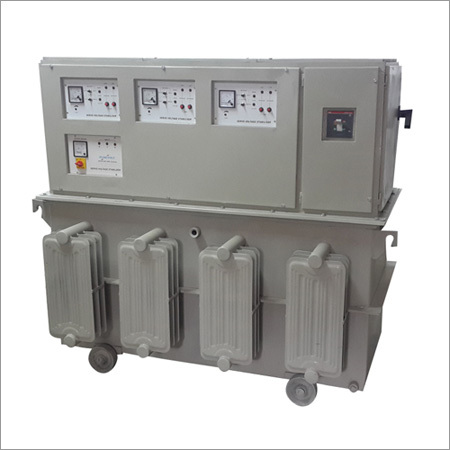
Tell us about your requirement

Price:
Quantity
Select Unit
- 50
- 100
- 200
- 250
- 500
- 1000+
Additional detail
Mobile number
Email

More Products in Voltage Stabilizers Category
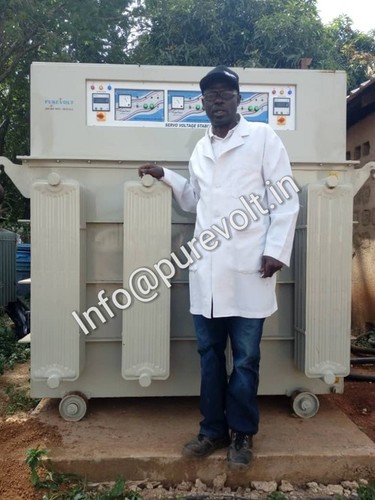
Servo Voltage Stabilizer
Price 135000.0 INR / Piece
Minimum Order Quantity : 1 Piece
Product Type : Stabilizer
Input Voltage : required based Ampere (A)
Display : Analog
Rated Power : 1kva to 2000kva
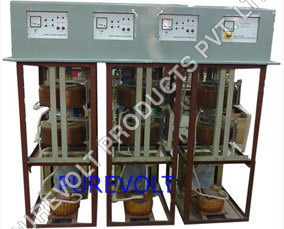
Oil Cooled Servo Voltage Stabilizer
Price 180000 INR / Piece
Minimum Order Quantity : 1 Piece
Product Type : Oil Cooled Servo Voltage Stabilizer
Input Voltage : 340460 V
Display : Analog
Rated Power : 500 KVA
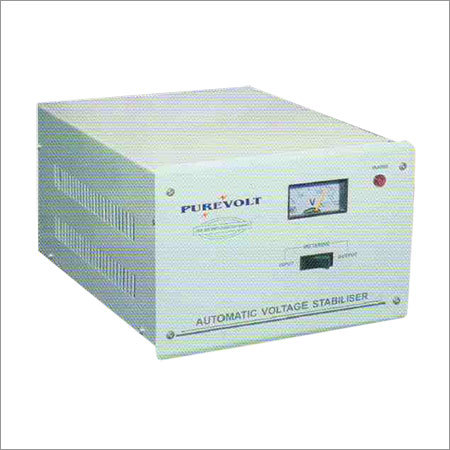
Voltage Stabilizer
Price 4500 INR
Minimum Order Quantity : 1 Piece
Product Type : Voltage Stabilizer
Input Voltage : 160260,140260 and 90260 Volt (V)
Display : Analog
Rated Power : Upto 30 KVA
3 Phase Servo Voltage Stabilizer
Price 7000 INR
Minimum Order Quantity : 1 Piece
Product Type : Voltage Stabilizer
Input Voltage : 340 480 Volt (V)
Display : Meter
Rated Power : 1 KVA 2000 KVA

We are catering to top Indian cities such as New Delhi/NCR, Noida, Faridabad, Ghaziabad, Greater Noida, Alwar, Manesar.
 Send Inquiry


Our Products


D-9/6, Okhla Industrial Area, Phase-I, New Delhi - 110020, India

Mr Sumit Gupta
(Director)
Mobile :08045803029
 Send Inquiry
 Send SMS
Developed and Managed by Infocom Network Private Limited.
 English
 Spanish
 French
 German
 Italian
 Chinese (Simplified)
 Japanese
 Korean
 Arabic
 Portuguese